

How to Make Successful Brand Selling on Amazon
In today’s digital economy, data is no longer just a byproduct of business operations—If it is a strategic asset. All organizations that effectively leverage data and analytics gain a significant competitive advantage by making smarter decisions, predicting trends, and delivering personalized customer experiences. Selling Brand that stay focused on delivering value, building relationships, and evolving with the market are the ones that achieve lasting success—not just on Amazon, but in the entire e-commerce landscape.

Why Data Matters More Than Ever
If every interaction—whether it’s a website visit, purchase, or customer inquiry—generates valuable data. When analyzed correctly, this data reveals patterns, behaviors, and opportunities that can drive growth.
Businesses that rely on intuition alone often miss hidden insights. In contrast, data-driven companies:
- Better always identify market trends early
- Also understand customer preferences deeply
- Always optimize operations efficiently
- Reduce risks and uncertainties
Types of Data That Drive Growth
To fully leverage analytics, businesses must understand the types of data available:
1. Customer Data
This includes demographics, purchase history, and behavior patterns. Also it helps businesses personalize offerings and improve customer retention.
2. Operational Data
Covers internal processes such as supply chain, inventory, and logistics. Analyzing this data improves efficiency and reduces costs.
3. Financial Data
Revenue, expenses, and profit margins help in forecasting and strategic planning.
4. Marketing Data
Always metrics like click-through rates, conversion rates, and campaign performance guide better marketing decisions.
Turning Data into Actionable Insights
Collecting data is only the first step. The real value lies in transforming it into actionable insights.
Data Collection and Integration
Use tools like CRM systems, analytics platforms, and ERP software to gather and centralize data from multiple sources.
Data Cleaning and Preparation
Ensure accuracy by removing duplicates, correcting errors, and standardizing formats.
Data Analysis
Apply techniques such as:
- Descriptive analytics (what happened)
- Predictive analytics (what might happen)
- Prescriptive analytics (what should be done)
Visualization
Dashboards and charts make complex data easier to understand, enabling quicker decision-making.
Key Benefits of Data-Driven Growth
1. Better Decision-Making
Data removes guesswork, allowing leaders to make informed and confident decisions.
2. Improved Customer Experience
Personalization based on data leads to higher satisfaction and loyalty.
3. Increased Efficiency
Analytics identifies bottlenecks and inefficiencies in operations.
4. Revenue Growth
Targeted marketing and optimized pricing strategies directly impact profitability.
Real-World Applications
- E-commerce: Recommending products based on browsing behavior
- Finance: Detecting fraud through anomaly detection
- Healthcare: Predicting patient outcomes
- Retail: Optimizing inventory based on demand forecasting
Challenges to Consider
While data offers immense potential, there are challenges:
- Data privacy and security concerns
- Lack of skilled professionals
- Poor data quality
- Integration issues across systems
Addressing these challenges requires investment in technology, training, and governance.
Best Practices for Leveraging Data
- Define clear business objectives before analyzing data
- Invest in the right tools and technologies
- Foster a data-driven culture within the organization
- Ensure data accuracy and consistency
- Continuously monitor and refine strategies
The Future of Data and Analytics
With many more advancements in artificial intelligence and machine learning, analytics is becoming more powerful and accessible. Businesses can now automate insights, predict customer needs, and make real-time decisions. The future belongs to organizations that not only collect data but also know how to use it effectively. If leveraging data and analytics is no longer optional—it is essential for sustainable growth. By transforming raw data into meaningful insights, businesses can unlock new opportunities, enhance customer experiences, and stay ahead in an increasingly competitive landscape.
The key is simple: collect smart, analyze deeply, and act decisively. Success on Amazon is no longer just about listing products—it’s about understanding the data behind every click, impression, and purchase. By tracking the right metrics and analyzing customer behavior, sellers can make smarter decisions that directly impact sales and profitability.
Key Amazon Metrics to Track
To grow effectively on Amazon, you must monitor the metrics that truly matter:
- Sessions (Traffic): Number of visits to your product listing
- Conversion Rate (Unit Session Percentage): Percentage of visitors who make a purchase
- Click-Through Rate (CTR): Percentage of shoppers who click your product after seeing it
- Buy Box Percentage: Frequency of winning the Buy Box
- ACoS (Advertising Cost of Sales): Measures ad spend efficiency
- ROAS (Return on Ad Spend): Revenue generated per rupee spent on ads
- Customer Reviews & Ratings: Direct impact on trust and conversions
Tracking these consistently helps you identify what’s working and what needs improvement.
Understanding Conversion Rate and CTR
Two of the most critical performance indicators on Amazon are CTR and Conversion Rate.
Click-Through Rate (CTR)
CTR shows how attractive your product is in search results.
Improvement Tips:
- Use high-quality main images
- Write compelling product titles
- Price competitively
- Add badges like “Best Seller” or discounts
Conversion Rate
If conversion rate reflects how well your listing convinces visitors to buy.
Improvement Tips:
- Optimize product descriptions and bullet points
- Use A+ Content for storytelling
- Add clear product benefits and features
- Showcase social proof (reviews, ratings)
👉 Simple Insight:
- Low CTR → Problem with visibility or appeal
- Low Conversion → Problem with listing quality or trust
Analyzing Customer Behavior
By understanding how customers interact with your product is key to growth.
What to Analyze:
- Search Terms: What Type of keywords bring traffic
- Click Patterns: Which products customers compare
- Time on Page: Indicates engagement level
- Cart Abandonment: Always shows friction in buying decision
Tools to Use:
- Amazon Brand Analytics
- Search Term Reports
- Advertising Campaign Data
Key Insight:
But customer behavior tells you why something is happening—not just what is happening. For example:
- High traffic but low sales → mismatch between expectation and product
- High clicks but no conversion → pricing or trust issue
Using Data to Optimize Listings and Ads
Data becomes powerful only when you act on it.
Listing Optimization
- Update keywords based on search term reports
- Improve images if CTR is low
- Rewrite bullet points if conversion is poor
- Adjust pricing based on competitor analysis
Advertising Optimization
- Pause keywords with high spend and low conversions
- Increase bids on high-performing keywords
- Test different ad creatives and formats
- Segment campaigns for better control
Continuous Testing
- A/B test images, titles, and pricing
- Experiment with different ad strategies
- Monitor performance weekly
If Amazon success is driven by data-backed decisions, not guesswork. Sellers who consistently track metrics, understand customer behavior, and optimize based on insights are the ones who scale faster and more sustainably.
Remember:
👉 Data tells a story.
👉 Your job is to listen, interpret, and act.
Building Brand Loyalty Beyond Amazon
Selling on Amazon is a powerful way to reach millions of customers—but true, long-term success comes from building a brand that customers remember, trust, and return to outside the platform. Also Relying only on Amazon limits your control over customer relationships. Building loyalty beyond it gives you ownership, repeat customers, and sustainable growth.

Why Go Beyond Amazon?
Amazon controls the marketplace, but you should control your brand.
Here’s why expanding beyond Amazon matters:
- If You don’t own customer data on Amazon
- Competition is high and often price-driven
- Brand differentiation is limited within listings
- Long-term growth depends on repeat customers
Building loyalty outside Amazon creates a direct connection with your audience.
1. Create a Strong Brand Identity
Always your brand should be more than just a product—it should represent a story, purpose, and emotion.
Key Elements:
- Unique brand voice and messaging
- Consistent visuals (logo, colors, packaging)
- Clear value proposition
Always Customers remember brands that feel authentic and consistent.
2. Deliver an Exceptional Product Experience
Your product is your strongest marketing tool.
Go Beyond Expectations:
- High-quality packaging
- Thoughtful unboxing experience
- Clear instructions and inserts
A memorable experience increases the chances of repeat purchases and word-of-mouth referrals.
3. Build a Direct Relationship with Customers
Amazon restricts direct communication, but you can still guide customers toward your ecosystem.
Strategies:
- Include inserts encouraging customers to visit your website
- Offer exclusive content or discounts off-Amazon
- Build an email list through value-driven offers
Owning your customer relationship is key to long-term loyalty.
4. Leverage Social Media Presence
Social media helps humanize your brand and engage customers beyond transactions.
Focus On:
- Storytelling about your brand
- User-generated content
- Behind-the-scenes insights
- Customer testimonials
Consistency builds familiarity—and familiarity builds trust.
5. Use Email Marketing for Retention
Email remains one of the most powerful tools for building loyalty.
What to Send:
- Product education and tips
- Exclusive offers and early access
- Personalized recommendations
Unlike Amazon, email gives you full control over communication.
6. Create a Community Around Your Brand
Loyal customers don’t just buy—they belong.
Ways to Build Community:
- Private groups (WhatsApp, Facebook, Discord)
- Loyalty programs and rewards
- Referral programs
When customers feel part of something, they stay longer and spend more.
7. Offer a Seamless D2C Experience
Having your own website strengthens your brand independence.
Benefits:
- Full control over branding and pricing
- Better margins (no marketplace fees)
- Access to customer data and insights
Make sure your website is:
- Easy to navigate
- Mobile-friendly
- Fast and secure
8. Focus on Post-Purchase Engagement
The relationship doesn’t end after the sale—it begins there.
Engage Customers With:
- Follow-up emails
- Usage tips and guides
- Feedback requests
- Loyalty rewards
A strong post-purchase strategy turns one-time buyers into repeat customers. Amazon can help you scale quickly—but it shouldn’t be your only growth strategy. To build a lasting brand:
- Think beyond transactions
- Focus on relationships
- Create experiences customers remember
In the end, products can be copied—but strong brands and loyal customers cannot.
Building Brand Loyalty Beyond Amazon: Key Strategies
Expanding beyond Amazon is essential for long-term brand success. While Amazon helps you acquire customers, your own ecosystem helps you retain, engage, and grow them into loyal advocates. Here’s how you can do it effectively:
Creating a Brand Website
A dedicated brand website gives you full control over your customer experience and brand identity.
Why It Matters:
- You own customer data
- No marketplace competition on your product page
- Higher profit margins (no platform fees)
What to Focus On:
- Clean Design: Make navigation simple and mobile-friendly
- Strong Branding: Use consistent colors, fonts, and messaging
- Clear Value Proposition: Tell visitors why your brand is unique
- Fast Checkout Experience: Reduce friction to increase conversions
Pro Tip:
Offer exclusive deals or bundles on your website to encourage Amazon customers to visit and purchase directly.
Using Social Media to Strengthen Brand Identity
Social media is where your brand comes alive beyond product listings.
Key Strategies:
- Storytelling: Share your brand journey and mission
- Consistency: Maintain a uniform tone and visual style
- Engagement: Reply to comments, messages, and feedback
- User-Generated Content: Encourage customers to share their experiences
Platforms to Focus On:
- Instagram for visuals and lifestyle branding
- LinkedIn for professional and B2B presence
- YouTube for product demos and storytelling
Pro Tip:
Don’t just sell—educate, entertain, and inspire your audience.
Email Marketing for Repeat Customers
Email marketing is one of the most powerful tools for customer retention.
Why It Works:
- Direct communication channel
- Personalized messaging
- High return on investment
What to Send:
- Welcome emails for new customers
- Product usage tips and guides
- Exclusive discounts and early access
- Re-engagement emails for inactive customers
Best Practices:
- Segment your audience based on behavior
- Keep emails short, valuable, and relevant
- Use automation for consistency
Pro Tip:
A well-timed email can turn a one-time buyer into a repeat customer.
Community Building and Customer Engagement
Strong brands don’t just have customers—they have communities.
How to Build a Community:
- Create private groups (WhatsApp, Facebook, Discord)
- Launch loyalty or rewards programs
- Encourage referrals and word-of-mouth
Engagement Ideas:
- Run contests and giveaways
- Feature customer stories
- Ask for feedback and suggestions
- Host live sessions or Q&A
Why It Matters:
When customers feel connected to your brand, they are more likely to:
- Buy repeatedly
- Recommend your brand
- Stay loyal even when competitors offer lower prices
Building brand loyalty beyond Amazon is about creating meaningful relationships, not just transactions.
Focus on:
- Owning your platform (website)
- Engaging consistently (social media & email)
- Building a tribe (community)
Remember: The brands that win long-term are the ones customers trust, remember, and proudly support.
Expanding Your Brand Portfolio
Growing a successful brand doesn’t stop with one winning product. To build a sustainable and scalable business, you need to expand your brand portfolio strategically. This means introducing new products or categories that align with your brand while meeting evolving customer needs.

Why Expanding Your Brand Portfolio Matters
Relying on a single product is risky. Market trends change, competition increases, and demand can fluctuate.
By expanding your portfolio, you:
- Reduce dependency on one product
- Increase revenue streams
- Strengthen brand authority
- Improve customer lifetime value
A broader portfolio allows your brand to grow deeper and wider in the market.
1. Start with Customer Insights
Your existing customers are your best source of ideas.
Ask:
- What problems are they trying to solve?
- What complementary products do they need?
- What feedback are they giving in reviews?
Example:
If you sell fitness bands, your next products could be:
- Resistance bands
- Yoga mats
- Protein accessories
This approach ensures your expansion is demand-driven, not guesswork.
2. Expand Within Your Niche First
Before jumping into new categories, dominate your current niche.
Benefits:
- Easier marketing and cross-selling
- Stronger brand positioning
- Higher trust from existing customers
Strategy:
- Add variations (size, color, bundles)
- Introduce complementary products
- Create product ecosystems
3. Focus on Complementary Products
The best expansions are products that naturally fit together.
Examples:
- Skincare brand → Cleanser, toner, moisturizer
- Kitchen brand → Utensils, storage containers, tools
- Pet brand → Food, toys, grooming products
This increases:
- Average order value
- Repeat purchases
- Customer convenience
4. Validate Before Scaling
Never launch blindly—test before investing heavily.
Ways to Validate:
- Small inventory batches
- Market research and keyword analysis
- Competitor review analysis
- Running test ads
Validation reduces risk and ensures product-market fit.
5. Maintain Quality and Consistency
As you expand, never compromise your brand standards.
Key Areas:
- Product quality
- Packaging consistency
- Customer experience
- Brand messaging
A weak product can damage trust across your entire portfolio.
6. Build a Strong Supply Chain
More products mean more complexity.
Ensure:
- Reliable suppliers
- Inventory management systems
- Efficient logistics
A strong backend supports smooth scaling without operational issues.
7. Leverage Cross-Selling and Bundling
Use your expanded portfolio to increase sales.
Strategies:
- Bundle related products
- Recommend complementary items
- Offer discounts on multi-product purchases
This boosts both revenue and customer satisfaction.
8. Explore New Categories Strategically
Once your niche is strong, consider expanding into adjacent markets.
Example:
A fitness brand can expand into:
- Apparel
- Nutrition
- Digital fitness programs
Make sure the new category still aligns with your brand identity.
Final Thoughts
Expanding your brand portfolio is not about launching more products—it’s about launching the right products.
Focus on:
- Customer needs
- Strategic alignment
- Consistent quality
- Smart validation
Growth comes from depth, not just breadth. Build a portfolio that strengthens your brand and delivers long-term value.
Scaling your brand requires more than just adding new products—it involves strategic expansion that increases value for customers while maximizing revenue. Here are four powerful approaches to grow your brand portfolio effectively.
Introducing Complementary Products
Complementary products are items that naturally go together and enhance the customer’s overall experience.
Why It Works:
- Solves multiple customer needs at once
- Increases average order value
- Encourages repeat purchases
Examples:
- Phone cases → Screen protectors, chargers
- Coffee makers → Coffee beans, mugs
- Fitness equipment → Resistance bands, water bottles
Strategy:
Start by analyzing customer behavior and reviews to identify what customers often need alongside your main product.
👉 Key Insight: The best complementary products feel like a “complete solution,” not just an extra purchase.
Bundling Strategies
Product bundling combines multiple items into a single package, often at a slightly discounted price.
Benefits:
- Increases perceived value
- Moves slow-selling inventory
- Simplifies buying decisions
Types of Bundles:
- Pure Bundles: Sold only as a set
- Mixed Bundles: Available individually and as a package
- Seasonal Bundles: Special offers during holidays or events
Example:
Instead of selling items separately:
- Shampoo + Conditioner + Hair Serum → “Complete Hair Care Kit”
👉 Pro Tip: Highlight savings clearly to make the bundle more attractive.
Cross-Selling and Upselling Techniques
These techniques help you maximize revenue from each customer interaction.
Cross-Selling
By Encouraging customers to buy related products.
Example:
“Customers also bought…” suggestions on Amazon listings.
Upselling
Encouraging customers to buy a higher-value version.
Example:
- Basic product → Premium version with added features
- Single pack → Multi-pack with discount
Best Practices:
- Keep recommendations relevant
- Avoid overwhelming the customer
- Use data (purchase history, behavior) to personalize suggestions
👉 Simple Rule:
- Cross-sell = add more items
- Upsell = upgrade the item
Expanding into International Amazon Marketplaces
Once you succeed in one marketplace, going global can unlock massive growth.
Popular Amazon Marketplaces:
- USA
- UK
- Germany
- Canada
- Australia
- UAE
Benefits:
- Access to new customer bases
- Diversified revenue streams
- Reduced dependency on one market
Key Considerations:
- Local regulations and taxes
- Currency and pricing strategy
- Cultural preferences and buying behavior
- Logistics and fulfillment (FBA global options)
Getting Started:
- Use Amazon Global Selling
- Research demand in target countries
- Start with a few products before scaling
👉 Pro Tip: Adapt your listings (language, keywords, images) for each market instead of copying the same content.
Expanding your brand portfolio is about creating more value per customer, not just increasing product count.
Focus on:
- Offering complete solutions (complementary products)
- Increasing perceived value (bundling)
- Maximizing each sale (cross-selling & upselling)
- Scaling globally (international marketplaces)
Smart expansion leads to stronger brands, higher revenue, and long-term success.
Avoiding Common Mistakes New Amazon Sellers Make
Starting an Amazon business can be exciting—but many new sellers make avoidable mistakes that slow down growth or even lead to failure. Understanding these pitfalls early can save you time, money, and frustration.
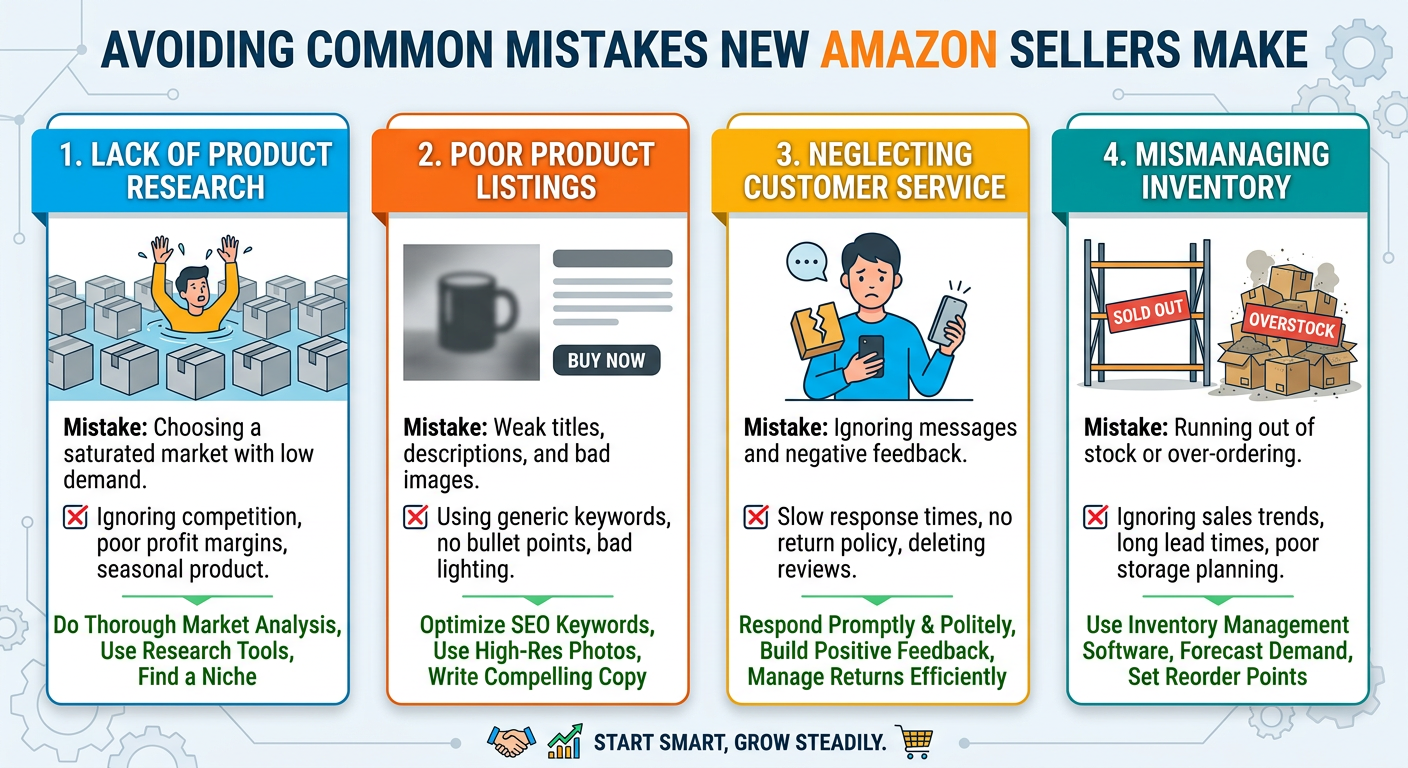
1. Choosing the Wrong Product
One of the biggest mistakes is selecting a product based on trends rather than data.
Common Issues:
- High competition with low differentiation
- Low demand or seasonal products
- Thin profit margins
How to Avoid:
- Conduct proper market research
- Analyze demand, competition, and pricing
- Focus on products with clear value addition
👉 Tip: Don’t chase trends—build a sustainable product strategy.
2. Poor Listing Optimization
Your product listing is your storefront. A weak listing leads to low visibility and poor conversions.
Mistakes:
- Low-quality images
- Unclear titles and bullet points
- Missing keywords
Fix:
- Use high-resolution images
- Write benefit-driven descriptions
- Optimize for relevant keywords
👉 Remember: First impressions drive clicks and sales.
3. Ignoring Customer Reviews
Reviews directly impact trust and sales.
Mistakes:
- Not responding to negative feedback
- Ignoring customer complaints
- Failing to improve product quality
Fix:
- Monitor reviews regularly
- Address issues quickly
- Use feedback to improve your product
👉 Insight: Reviews are free market research.
4. Poor Inventory Management
Running out of stock or overstocking can hurt your business.
Risks:
- Stockouts → Loss of ranking and sales
- Overstock → Increased storage fees
Solution:
- Track sales trends
- Forecast demand accurately
- Maintain optimal inventory levels
👉 Balance is key: Avoid both shortage and excess.
5. Mismanaging Advertising Spend
Many beginners either overspend or avoid ads completely.
Mistakes:
- Running ads without strategy
- Ignoring ACoS and ROI
- Not optimizing campaigns
Fix:
- Start with small budgets
- Track performance metrics
- Scale only what works
👉 Tip: Ads should be an investment, not a gamble.
6. Competing Only on Price
Lowering prices to beat competitors is a short-term strategy.
Problems:
- Reduced profit margins
- Brand devaluation
- Price wars
Better Approach:
- Focus on quality and branding
- Highlight unique selling points
- Build customer trust
👉 Win with value, not just price.
7. Neglecting Branding
Many sellers treat Amazon like a quick-selling platform instead of building a brand.
Mistakes:
- Generic packaging
- No brand identity
- No off-Amazon presence
Fix:
- Create a memorable brand
- Invest in packaging and storytelling
- Build presence on social media and website
👉 Strong brands survive competition.
8. Not Understanding Amazon Policies
Ignoring Amazon’s rules can lead to account suspension.
Common Violations:
- Fake reviews
- Listing manipulation
- Policy non-compliance
Solution:
- Stay updated with Amazon policies
- Follow ethical practices
- Avoid shortcuts
👉 Protect your account—it’s your business foundation.
9. Lack of Data-Driven Decisions
Operating without data is like flying blind.
Mistakes:
- Ignoring analytics
- Making decisions based on assumptions
- Not tracking key metrics
Fix:
- Monitor performance regularly
- Use data to guide strategy
- Continuously optimize
👉 Data = Direction.
Mistakes are part of the journey—but the smart sellers learn early and adapt quickly. By Avoiding these common pitfalls will help you:
- Save money
- Grow faster
- Build a sustainable Amazon business
Success on Amazon isn’t about luck—it’s about learning, adapting, and improving consistently.
Building a successful Amazon business requires more than just listing products and running ads. Many sellers struggle because they overlook key fundamentals. Here are five critical mistakes—and how to avoid them.
Ignoring Branding and Focusing Only on Sales
Many beginners treat Amazon as a quick-selling platform rather than a place to build a long-term brand.
The Problem:
- Generic products with no differentiation
- No emotional connection with customers
- Easily replaceable by competitors
The Solution:
- Develop a unique brand identity (logo, packaging, voice)
- Tell a compelling brand story
- Focus on customer experience, not just transactions
👉 Key Insight: Sales bring revenue, but branding builds loyalty and long-term success.
Poor Financial Planning
A profitable-looking business can fail without proper financial management.
Common Mistakes:
- Ignoring hidden costs (Amazon fees, ads, shipping)
- Poor pricing strategies
- No cash flow planning
What to Do:
- Track all expenses carefully
- Calculate true profit margins
- Maintain a budget for inventory and ads
- Plan for reinvestment
👉 Rule: Revenue is vanity, profit is sanity.
Skipping Product Validation
Launching a product without validation is a high-risk move.
The Risk:
- Low demand
- High competition
- Unsold inventory
How to Validate:
- Conduct keyword and demand research
- Analyze competitor reviews
- Test with small inventory batches
- Run trial ad campaigns
👉 Smart Approach: Test first, scale later.
Neglecting Customer Service
Customer experience is a major factor in your Amazon success.
Common Issues:
- Slow response to queries
- Ignoring complaints
- Poor handling of returns
Best Practices:
- Respond quickly and professionally
- Resolve issues proactively
- Focus on customer satisfaction
Why It Matters:
- Better reviews
- Higher seller ratings
- Increased repeat purchases
👉 Insight: Happy customers become repeat customers—and brand advocates.
Over-Reliance on Paid Advertising
Ads can drive traffic, but depending only on them is risky.
The Problem:
- Rising ad costs
- Reduced profit margins
- No organic growth
Balanced Strategy:
- Optimize listings for organic ranking (SEO)
- Build external traffic sources (social media, website)
- Use ads strategically, not blindly
👉 Golden Rule: Ads should support your business, not sustain it entirely.
Avoiding these mistakes can significantly improve your chances of success on Amazon.
Focus on:
- Building a brand, not just making sales
- Managing finances wisely
- Validating before investing
- Prioritizing customer experience
- Creating a balanced growth strategy
In the long run, disciplined and strategic sellers always outperform quick, reactive ones.
Long-Term Brand Sustainability
Long-term brand sustainability is the ability of a brand to remain relevant, trusted, and profitable over time—while adapting to changing market conditions, customer expectations, and global challenges. It goes beyond short-term sales and focuses on building a resilient, ethical, and future-ready brand.

1. Build a Strong Brand Identity
A sustainable brand starts with a clear identity—your mission, vision, values, and unique positioning. Customers connect with brands that stand for something meaningful.
- Define your brand purpose beyond profit
- Maintain consistency in messaging and visuals
- Communicate authenticity across all channels
2. Prioritize Product Quality and Innovation
Quality builds trust, and innovation keeps your brand relevant.
- Continuously improve your product offerings
- Invest in research and development
- Adapt to new trends without losing core identity
3. Focus on Customer Relationships
Long-term success depends on loyal customers, not one-time buyers.
- Deliver excellent customer service
- Personalize experiences
- Encourage feedback and act on it
4. Embrace Sustainability and Ethical Practices
Modern consumers prefer brands that care about the environment and society.
- Use eco-friendly materials and packaging
- Ensure ethical sourcing and fair labor practices
- Reduce waste and carbon footprint
5. Diversify Revenue and Marketing Channels
Relying on a single platform is risky. A sustainable brand spreads its presence.
- Sell across multiple platforms (Amazon, website, retail)
- Build organic traffic through content and SEO
- Leverage social media and email marketing
6. Maintain Financial Discipline
Sustainability also means financial health.
- Monitor cash flow and profitability
- Avoid overspending on ads without ROI
- Plan for long-term investments
7. Stay Adaptable to Market Changes
Markets evolve quickly—brands must evolve too.
- Track industry trends and customer behavior
- Be open to pivoting strategies
- Use data to make informed decisions
8. Invest in Brand Trust and Reputation
Trust is one of the most valuable long-term assets.
- Be transparent in communication
- Handle crises responsibly
- Build credibility through reviews and testimonials
Long-term brand sustainability is not built overnight—it requires consistent effort, strategic thinking, and a deep understanding of your customers and market. Brands that focus on value, trust, and adaptability are the ones that thrive for decades.
If you want, I can turn this into a LinkedIn post, blog article, or presentation for your business.
Continuous Product Innovation
Continuous product innovation is essential for keeping your brand relevant in a fast-changing marketplace like Amazon. Customer preferences evolve, competitors improve, and trends shift quickly—so your products must do the same.
- Regularly analyze customer reviews to identify improvement areas
- Introduce new features, variations, or bundles
- Stay updated with market trends and emerging needs
- Test new ideas with small launches before scaling
Innovation doesn’t always mean creating something entirely new—it often means making your existing products better, smarter, and more customer-focused.
Adapting to Amazon Policy Changes
Amazon frequently updates its policies to improve customer experience and marketplace integrity. Sellers who fail to adapt risk account suspension or listing removal.
- Stay informed through Amazon Seller Central announcements
- Regularly review account health and performance metrics
- Ensure listings comply with guidelines (images, claims, keywords)
- Keep documentation ready for verification requests
Being proactive—not reactive—helps you avoid disruptions and maintain steady business operations.
Maintaining Competitive Advantage
To sustain long-term success, your brand must stand out in a crowded marketplace. Competitive advantage is what makes customers choose you over others.
- Develop a strong Unique Selling Proposition (USP)
- Focus on branding, packaging, and storytelling
- Optimize pricing without compromising value
- Leverage data and analytics to outperform competitors
Your edge could be quality, price, customer experience, or innovation—but it must be clear and consistent.
Building a Strong Reputation Over Time
A strong reputation is one of the most valuable long-term assets for any brand. It builds trust, drives repeat purchases, and attracts new customers organically.
- Deliver consistent product quality and service
- Encourage satisfied customers to leave reviews
- Respond professionally to negative feedback
- Maintain transparency and honesty in communication
Reputation isn’t built overnight—but once established, it becomes a powerful driver of sustainable growth.
Sustainable success on Amazon comes from balancing innovation, compliance, differentiation, and trust. Brands that master these four pillars are far more likely to grow steadily and withstand market challenges.
Future Trends in Amazon Brand Building
Amazon brand building is evolving rapidly with technology, changing customer behavior, and increasing competition. To stay ahead, sellers must align with the future of eCommerce and adapt their strategies accordingly.

1. AI-Driven Branding and Personalization
Artificial Intelligence is transforming how brands connect with customers on Amazon.
- AI tools help optimize listings, ads, and product recommendations
- Conversational shopping (AI assistants) is changing how customers search and buy
- Personalized experiences improve conversions and customer satisfaction
👉 In the future, brands that leverage AI for smarter decisions will dominate visibility and sales.
2. Voice Search and Conversational Commerce
Shopping behavior is shifting from typing to talking.
- Customers increasingly use voice assistants and AI chat-based search
- Queries are becoming more specific and intent-driven
- Product listings must be optimized for natural language
This means brands need to rethink SEO—from keywords to real customer questions.
3. Social Commerce and Influencer Integration
Amazon is no longer just a marketplace—it’s becoming part of a larger social ecosystem.
- Influencers and creators drive purchase decisions through content
- Short-form videos and live shopping boost engagement
- Social proof is becoming more powerful than traditional ads
👉 Future brands will combine Amazon listings with strong off-platform branding.
4. Sustainability and Ethical Branding
Consumers are becoming more conscious about what they buy.
- Demand for eco-friendly products and packaging is rising
- Brands focusing on sustainability gain long-term trust
- Circular economy practices (reuse, recycle) are growing
Sustainability will shift from a “nice-to-have” to a “must-have.”
5. Omnichannel Brand Presence
Relying only on Amazon is no longer enough.
- Brands are expanding to DTC websites and other marketplaces
- Amazon logistics is being used beyond the platform (multi-channel fulfillment)
- Unified inventory and cross-channel selling are becoming standard
👉 The future belongs to brands, not just Amazon sellers.
6. Data-Driven Decision Making
Successful brands will rely heavily on analytics.
- Metrics like conversion rate, ROAS, and customer behavior guide strategies
- Predictive analytics helps forecast demand and trends
- Data improves pricing, inventory, and marketing efficiency
7. Faster Delivery and Customer Experience
Speed is becoming a competitive advantage.
- Quick commerce and same-day delivery expectations are rising
- Logistics efficiency directly impacts brand perception
- Better fulfillment = higher customer satisfaction
8. Enhanced Content and Brand Storytelling
Basic listings are no longer enough.
- High-quality images, videos, and A+ Content increase conversions
- Storytelling builds emotional connection with customers
- Brands must focus on experience, not just product features
9. Automation and Smart Operations
Automation is becoming the foundation of scaling.
- AI tools manage ads, inventory, and customer service
- Workflow automation is now standard among top sellers
- Reduces manual effort and improves efficiency
10. Zero-Click and Frictionless Shopping
The buying journey is becoming shorter and faster.
- Customers can purchase directly from search or AI interfaces
- Less browsing, more instant decisions
- Brands must focus on visibility, ratings, and pricing
The future of Amazon brand building is technology-driven, customer-centric, and highly competitive. Success will depend on how well you combine AI, branding, data, and customer experience into a single strategy.
Brands that evolve beyond just selling—and focus on building trust, identity, and innovation—will lead the next decade of eCommerce.
AI and Automation in E-commerce
Artificial Intelligence and automation are reshaping how e-commerce businesses operate and scale. From product research to customer service, AI enables faster, smarter, and more efficient decision-making.
- Automate repetitive tasks like inventory updates, pricing, and ad optimization
- Use AI tools for keyword research, listing optimization, and demand forecasting
- Implement chatbots for instant customer support
- Improve operational efficiency while reducing human error
👉 In the future, sellers who embrace automation will save time, cut costs, and scale faster than competitors.
Personalization and Customer Experience
Modern customers expect tailored experiences rather than generic interactions. Personalization helps brands connect with customers on a deeper level.
- Recommend products based on browsing and purchase history
- Customize email campaigns and offers
- Enhance user experience with relevant content and suggestions
- Focus on fast delivery, easy returns, and seamless support
👉 Better experiences lead to higher conversions, repeat purchases, and long-term loyalty.
Sustainability and Eco-Friendly Branding
Sustainability is no longer optional—it’s becoming a core expectation among consumers. Brands that adopt eco-friendly practices gain trust and long-term credibility.
- Use recyclable or biodegradable packaging
- Reduce carbon footprint through efficient logistics
- Ensure ethical sourcing and responsible manufacturing
- Communicate sustainability efforts transparently
👉 Eco-conscious branding not only benefits the planet but also strengthens customer trust and brand loyalty.
Voice Search and Mobile Optimization
With the rise of smartphones and voice assistants, shopping behavior is shifting rapidly toward mobile and voice-based interactions.
- Optimize product listings for conversational, long-tail keywords
- Ensure mobile-friendly design with fast loading speeds
- Simplify navigation and checkout processes
- Adapt content for voice queries and natural language search
👉 Brands that optimize for mobile and voice will capture the growing segment of on-the-go and hands-free shoppers.
The future of e-commerce lies in smart technology, personalized experiences, responsible practices, and seamless accessibility. Businesses that align with these trends will not only stay competitive but also build strong, future-ready brands.
Conclusion:
Building a successful brand on Amazon requires more than just selling products—it’s about delivering consistent quality, building customer trust, and continuously improving. Focus on strong branding, customer satisfaction, data-driven decisions, and adapting to market trends.
👉 In short: Success comes from quality, trust, innovation, and consistency over time.